

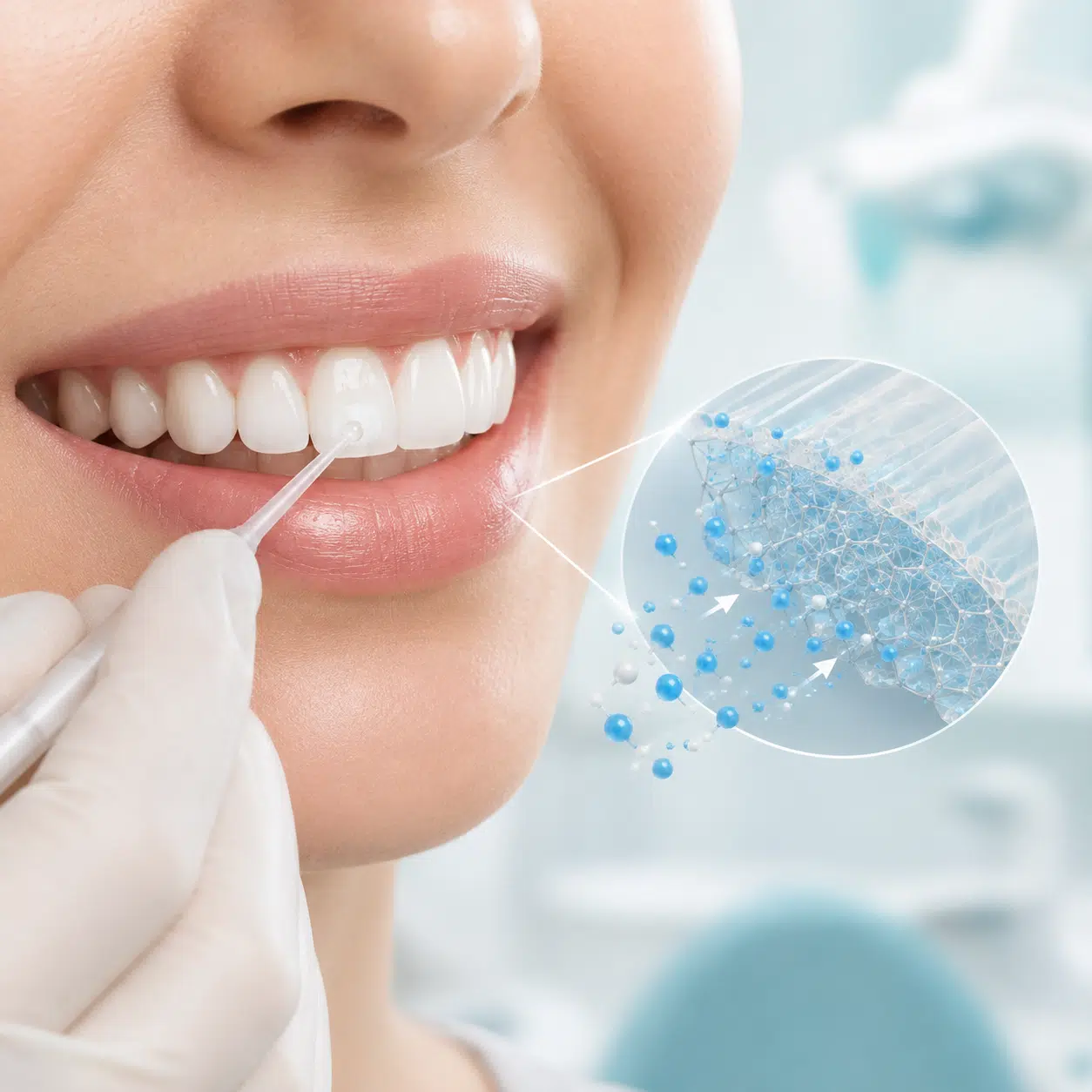
For a century, the only real answer to a cavity was to remove tooth structure and replace it with something manufactured. Curodont Repair changes the order of operations. It is a peptide treatment — a self-assembling protein called P11-4 — that soaks into a weakened, demineralised area of enamel and forms a scaffold inside it. Your own saliva then does the rebuilding, depositing mineral back into the lesion from the inside out.
There is no drilling, no anesthetic, and no filling material. The application itself takes about five minutes: we clean and condition the surface, place the peptide, and let it absorb. Over the following weeks and months the tooth remineralises and, in many cases, the white or brown spot fades noticeably as the enamel behind it regains density.
It is not a fix for everything. Curodont works on early lesions — enamel that has softened but not yet collapsed into a hole.
Those chalky patches near the gumline are enamel that has lost mineral and turned porous, which is why they catch the light differently. As the peptide scaffold refills them, the optical difference softens and the spot blends back toward the surrounding tooth.
A lesion that shows on an X-ray or a scan but has not yet broken through the enamel surface is the ideal candidate. Treating it now often means never needing a filling in that tooth — and never starting the cycle of replacing that filling every decade.
Brackets make certain spots almost impossible to keep clean, and demineralisation shows up the day they come off. This is one of the most rewarding uses of the treatment — finishing orthodontics with an even surface rather than a row of pale outlines.
Exposed root surfaces and thinned enamel let temperature reach the nerve. Rebuilding mineral density in those areas seals the pathway, and many patients notice cold and sweet triggers easing within a few weeks of treatment.

First we confirm the lesion is the right kind. That means a look with magnification, a digital scan, and usually an X-ray to check the depth — the whole point of this treatment is that it works below the surface, so we need to know the surface is still intact.
Then the tooth is cleaned, briefly conditioned to open the pores of the enamel, and rinsed. A single drop of the peptide solution is placed on the site and left to absorb for a few minutes. It diffuses into the lesion and self-assembles into a three-dimensional matrix that mimics the protein framework enamel originally grew on. That is the entire procedure — no numbing, no vibration, nothing to recover from.
You eat and drink normally afterwards. Remineralisation happens quietly over the following weeks, driven by the calcium and phosphate already in your saliva, and we photograph the tooth so the change is measured rather than remembered. Most patients are re-evaluated at their next cleaning; some deeper lesions benefit from a second application.
A filling costs you healthy tooth structure on either side of the decay, permanently. Peptide therapy adds mineral instead of subtracting enamel, which keeps the tooth stronger for the decades it still has to last.
The application fits inside a routine hygiene visit, and often gets added to one. No second appointment, no lab, no temporary — you leave with the treatment already working and no numb lip to wait out.
For people who dread the sound of a handpiece — and for children who have not yet learned to — being able to treat decay with a drop of solution changes the entire relationship with the dental chair.
We will look, image, and tell you plainly whether your lesion is early enough to respond. If it is not, we say so — a treatment that cannot reach the problem is not a bargain at any price.
Gilbert, AZ
A clear solution containing P11-4, a self-assembling peptide. Applied to a demineralised area, it diffuses in and organises itself into a scaffold resembling the protein framework enamel first formed around. Minerals from your saliva then crystallise onto that scaffold, restoring density from within rather than patching the surface.
No. There is no drilling and no injection, so no anesthetic is needed. The conditioning step tastes slightly sour for a few seconds and that is the extent of it. Children generally tolerate the visit better than a routine cleaning.
Remineralisation is gradual. Sensitivity often eases within a few weeks; visible fading of a white spot usually becomes apparent over one to six months as the enamel regains translucency. We take before photographs so the comparison is objective rather than a matter of memory.
Only for early lesions where the enamel surface is still intact. Once decay has cavitated — broken through into a physical hole — there is no structure left for the peptide to rebuild within, and a filling or crown is the correct treatment. Diagnosis decides this, not preference.
Fluoride hardens the outer layer, which slows a lesion but seals the deeper porous body away. The peptide is small enough to pass through that surface and work inside the lesion. The two are complementary — we generally continue fluoride as maintenance alongside treatment.
The material is a biocompatible peptide applied topically in a very small quantity, with no anesthetic and no drilling involved. It is widely used in paediatric care for exactly that reason. As with any treatment during pregnancy, tell us and we will review timing with you first.
Coverage varies and many plans still have no code for regenerative treatment, so it is often an out-of-pocket item. We quote it before we begin, and we will compare it against the cost of the filling — and the eventual replacement of that filling — so the decision is made with real numbers.
The mineral that rebuilds is your own, so it behaves like the rest of your enamel — durable, but not immune to the habits that caused the lesion. Sugar frequency, dry mouth, and hygiene all still matter. We monitor treated sites at each cleaning and re-apply if a site is not progressing.